Hey, C-suite leaders, let’s talk AI. You’ve probably seen it: the buzz around Microsoft Copilot (or similar tools) hits your organization, and suddenly there’s a “pilot group” of enthusiastic volunteers testing it out. Emails get summarized faster. Presentations pop together in minutes. Everyone’s excited about the productivity leap.
But here’s the quiet truth many organizations discover the hard way: without formal training, those pilots often fizzle. Tools sit underused. Risks creep in. And the expected ROI? It stays just out of reach.
At KnowledgeWave, we’ve spent years partnering with organizations just like yours—50 to 1,500 employees across North America—helping them move from “AI experimentation” to real, sustainable value. Our live webinars, on-demand Copilot courses, and adoption support are built exactly for teams that don’t have massive internal L&D departments. Today, we’re pulling back the curtain on why training isn’t a nice-to-have when you’re rolling out AI. It’s the difference between hype and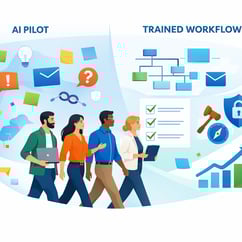 results.
The Pilot Trap: Enthusiasm Without Expertise
It makes perfect sense on paper. Pick a small group, give them Copilot access, and watch the magic happen. Many of our clients started this way—smart, forward-thinking leaders wanting to dip a toe in the AI pool before diving in.
So, what's the problem? Most pilot participants are self-taught or learning by trial-and-error. They figure out basic prompts, maybe generate a decent email draft, but they miss the deeper capabilities: turning a messy Excel sheet into insights in seconds, summarizing an entire Teams thread while respecting your data policies, or chaining prompts across Word, Outlook, and PowerPoint for true workflow transformation.
Without structured guidance, adoption plateaus. Productivity gains stay modest. And when questions arise about “What happens to my data?” or “Is this output compliant?”, there’s no clear answer. Sound familiar? You’re not alone and it’s fixable.
Read: Role-Based Copilot Training: How KnowledgeWave Designs Webinars That Drive Adoption.
Productivity: Turning AI from a Novelty into a Daily Superpower
Formal training supercharges productivity in ways casual use never can. Think of Copilot not as a chatbot, but as a colleague who never sleeps and who’s exceptional when you know exactly how to brief it.
Our Introduction to Microsoft Copilot webinar (and the follow-up role-specific sessions, or targeted application sessions on Word, Excel, Outlook, and PowerPoint) teach the “art of the prompt” alongside practical workflows.
Participants learn to:
-
Draft, edit, and summarize documents while maintaining your brand voice.
-
Analyze data trends and build charts without wrestling formulas.
-
Summarize email threads or meeting recaps in seconds.
The result? Knowledge workers reclaim hours every week for high-value work. One of the most common pieces of feedback we hear after training: “I didn’t realize how much time I was wasting until I saw what Copilot could actually do with the right guidance.”
Andrew Ng, one of the world’s leading AI educators, puts it perfectly: “Already today, every knowledge worker can get a meaningful productivity boost by using generative AI. Part of the challenges though, most people will need a little bit of training to know how to use AI responsibly and safely.”
Watch Andrew Ng on Washington Post Live
For mid-sized organizations, that boost compounds fast. You don’t need an army of data scientists—just equipped teams who treat AI as a tool, not a toy.
Security: Don’t Let Enthusiasm Create Hidden Risks
AI tools like Copilot are incredibly powerful because they tap into your organization’s data. That’s also what makes them potentially risky without the right guardrails.
Pilot groups often experiment freely—uploading sensitive files, sharing outputs externally, or prompting in ways that inadvertently expose information. Without training on data boundaries, access controls, and responsible use, you’re essentially handing the keys to a powerful engine and hoping everyone drives safely.
Formal Copilot training addresses this head-on. We cover how Copilot respects your Microsoft 365 permissions and tenant boundaries, best practices for sensitive data, and why understanding “what Copilot sees” matters. It aligns perfectly with broader secure-adoption steps: cleaning up redundant data, enforcing policies, and running risk assessments before scaling.
Satya Nadella, Microsoft’s CEO, has been clear about the stakes. He emphasizes that the biggest obstacle to expanding AI isn’t the technology—it’s “persuading people to change the way they work.” And he stresses reskilling as the best protection against displacement: “The best protection against displacement is to understand the new medium, the new tool, the new skills required and to transform yourself.”
Training builds that muscle. It turns security from a scary “IT problem” into something every user owns.
Governance: Building Responsible AI That Scales
Governance isn’t just about checkboxes—it’s about creating a framework where AI delivers consistent, compliant, and trustworthy results. For mid-sized organizations without dedicated AI ethics teams, this is where pilots often hit a wall.
Who owns the output? How do we ensure hallucinations are caught? What policies govern prompt engineering or data retention? Training provides the shared language and practices to answer these questions before they become issues.
Read This Post: Does my company need an AI policy?
Our customizable sessions include real-world examples of governance in action: setting content access parameters, evaluating outputs critically, and aligning AI use with your existing compliance standards. The result is confidence at every level—from the pilot group to leadership—that AI is being used responsibly.
Jensen Huang, NVIDIA’s CEO, captures the competitive reality: “You’re going to lose your job to somebody who uses AI.” The flip side is equally true for organizations: the ones that train their people win.
Andrew Ng drives the point home for leaders: “You have to reskill your workforce not just to create a wealthier society but a fairer one.” And Satya Nadella’s famous mantra fits perfectly here: “Don’t be a know-it-all; be a learn-it-all.”
Why This Matters Most for Organizations Like Yours
Huge enterprises can build internal AI academies and dedicated teams. Mid-sized organizations (50–1,500 employees) usually can’t and shouldn’t have to. You need practical, affordable, expert-led training that fits busy schedules and delivers immediate ROI.
That’s exactly why we designed our Copilot training at KnowledgeWave the way we did: short, focused live webinars (30–60 minutes) you can attend from anywhere, on-demand videos for self-paced learning, and the option to feed everything into your existing LMS. We also offer adoption consulting to help you move from pilot to full rollout smoothly.
Our clients—businesses, financial institutions, nonprofits, manufacturers, and more—tell us the same thing: the combination of live instruction, ongoing updates (because AI evolves fast), and examples tailored to real workflows makes training stick. No travel. No massive upfront investment. Just results.
Ready to Move Your AI Pilot from Experiment to Advantage?
AI isn’t going away. The organizations that treat it like any other strategic investment—by pairing great tools with great training—will pull ahead. Those that rely on enthusiasm alone will watch their pilots stall while competitors surge.
If your team is already piloting Copilot (or thinking about it), now is the perfect time to add the training layer that turns good intentions into measurable gains in productivity, security, and governance.
At KnowledgeWave, we make it simple.
AI is here. Let’s make it work for your people.
(And if you’re ready for that next step, we’re ready to help. Call us at 800.831.8449 or complete the form here: Request More Info about Copilot Training.
KnowledgeWave resources are Microsoft 365 Training Experts and we provide Live, on-demand, and LMS-ready AI & Copilot learning content training designed for real organizations.